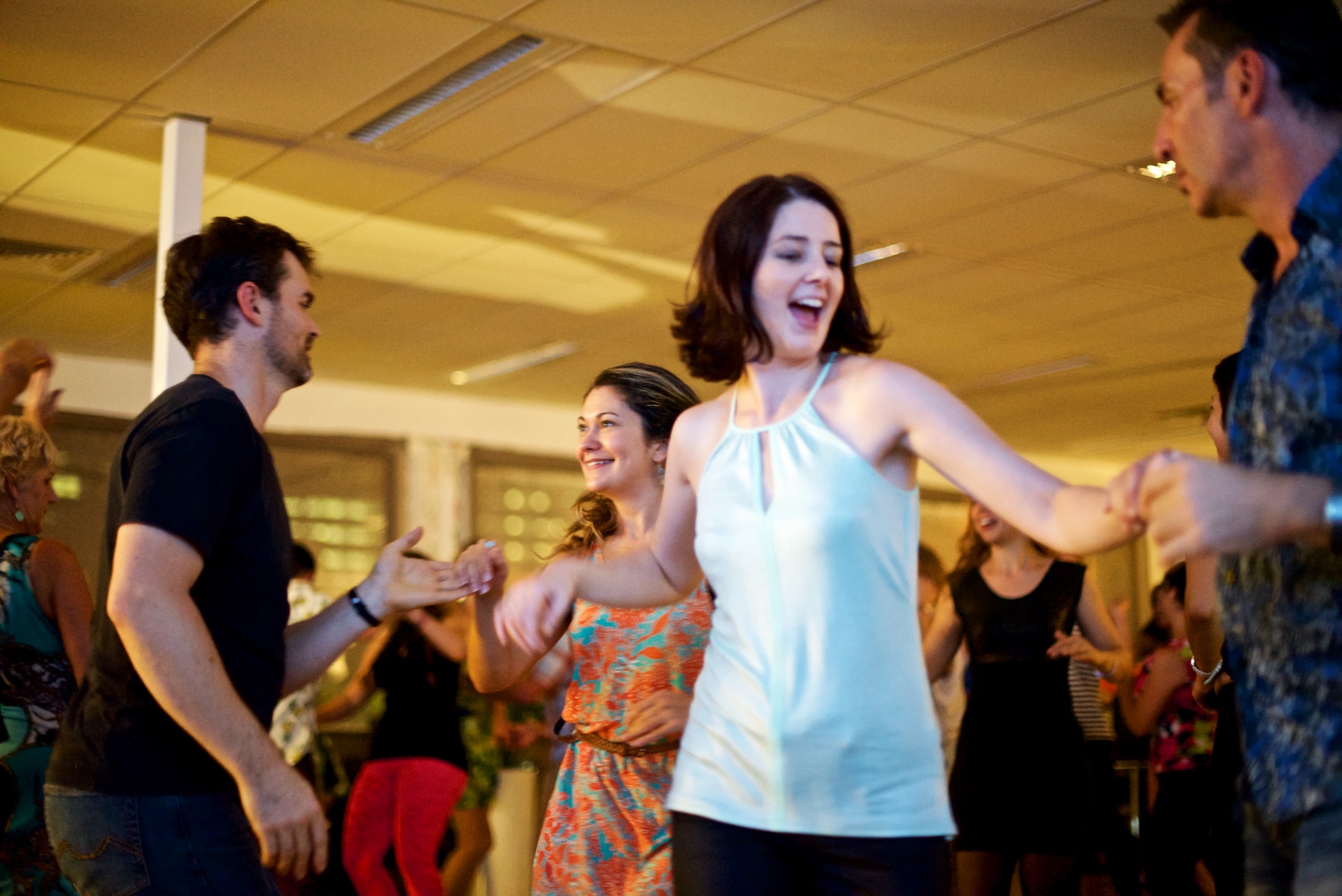
At Kmotion Dance Studio, we have a range of classes for all levels and experience. Each term runs for 6 weeks, builds progressively, and teaches steps, partnership, musicality and expression!
Bookings essential as class sizes are limited, so places will be given to those who’ve booked and paid first. Discounts apply for doing more than one class a week, however no discounts apply after term has started.
We also offer private lessons to fast-track your dancing! Individual attention allows you to work on technique, style, advanced material and new dances. Flexible times available. And for extra fun, ask us about Bridal Dances, Workshops and Bootcamps!
CLASS LEVELS
Open – All levels and experience!
Level 1 – Foundations. Absolutely no experience needed, provides you with all the fundamentals in that dance.
Level 2 A, B, C – Interchangeable (can be taken in any order),
all must be completed before going to 3.
Level 3 A, B, C – Interchangeable (can be taken in any order),
all must be completed before going to 4.
Level 4 – Advanced. Material varies each term. Must have completed all 2 and 3.
Masters – Invitation only.
Brazilian Zouk
Brazilian Zouk is a flowing, graceful dance that reflects passion and connection between two partners. Originating in Brazil in the 1980s, this dance is characterised by hair flicks, flowing ‘wave’ motions and a smooth, elegant rhythm. Beautiful to watch and fun to dance, it is easy to see why Zouk Lambada has been coined the ‘dance of love!’
Zouk has origins in Lambada, a partner dance favoured in Brazil and beyond from the 1980s onward. As Lambada music became rarer, the dance style began to fall out of favour. When Caribbean Zouk music styles became more popular throughout Brazil, the Lambada style of partnered dancing combined with modern dance styles created the “Brazilian Zouk” style.
Join the following KMotion Classes:
Zouk Lambada 1
Zouk Lambada 2C
Zouk Lambada 3C
Zouk Lambada 4
Zouk Origins + Zouk Social
Kizomba
An evolution of the traditional Semba, Kizomba is a highly sensual dance that originated in Angola. It gained a great deal of popularity during the 1990s and has since become a tremendous success in Europe, Ghana and Australia.
Kizomba features fluid hip movements, a close connection between partners and originally a slow, romantic rhythm. In recent years it has been influenced by tango and zouk moves.
Join the following KMotion Classes:
Kizomba 1
Kizomba 2B
Kizomba 3B
Bachata
From the Dominican Republic, the Bachata has its origins in Bolero and Son – Featuring a basic step pattern, simple turns and an element of free-style, Bachata has expanded from its origins in the Dominican Republic and is now danced all over the world.
Loved by many, Bachata literally means ‘party’ and is a super fun way to experience the wonderful rhythms of Latin American dance.
Salsa – Rueda
In 1928 Ignacio Pineiro entitled a new song, “Echale Salsita!” Meaning “spice it up” the phrase was eventually simplified to Salsa and then in the 1970’s the phrase was recoined as a generic term for a diverse mixture of Latino music and rhythms.
Salsa originated from the Cuban Son with a variety of influences from Danzon, Mambo, Guaguanco and other Afro-Cuban folkloric dances. Over the decades it has evolved into 3 major styles – Cuban (Casino), New York style (Mambo ‘on 2’), and LA style (‘on 1’), with other branches like Colombian Salsa (Cali) and Miami style.
Rueda originated during the 1950s and the name translates to ‘wheel’. It’s based on Cuban Salsa patterns, and is danced in a circular formation, with moves called out by one person (the Caller, Lider or Cantante) which the whole circle then execute. With its intricate patterns and regular swapping of partners, the Rueda is incredibly fun to watch and learn.
Regardless of the style, Salsa / Rueda is known for its fun and flirty nature, often with impressive spins, patterns and hip movement, and is one of the most popular latin dances today.
Argentine Tango
Originating in the late 19th Century, the seductive Argentine Tango boasts a history filled with passion and intrigue. It began in the lower classes of Buenos Aires, however was soon transported into the sophisticated soirees of Paris and was admired for its remarkable sense of emotion and sensuality. Characteristics include a closed stance, walking pace and intricate steps of the feet. A truly tantalizing dance, it is easy to see why the Argentine Tango has maintained its popularity. Esto es Tango- this is Tango.
The History of Tango began in Buenos Aires, Argentina in the late 19th Century. The dance started in the slums of Buenos Aires taking place in bars, cafes and courtyards. Then Tango took the next step into the more established Dancing houses and later inside the middle and high class Argentinian homes.
Argentine Tango is danced in closed stance, with most of the action happening in the intricate steps of the feet. Essentially Tango is walking with a partner and music.
CONTACT
Karen Rutherfoord | Director & Owner
info@kmotiondance.com.au | 0421 222 940
or message us below:
like us
Follow us
LOCATION
KMotion Dance Studio | Canberra Seniors Centre, 10 Watson St, Turner